Guides
Whetstone grits explained: what do #1000 and #6000 mean?
Miyabi workshop staff · Updated:
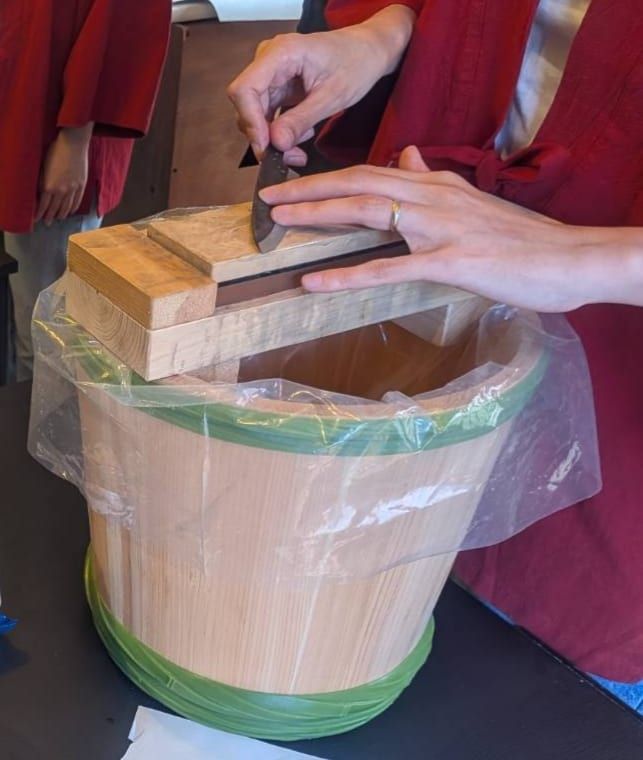
If you have ever looked at Japanese whetstones, you will have seen numbers like #400, #1000 or #6000. These are grit numbers, and understanding them is the easiest way to know which stone to use and when. In our workshop we use two stones, #1000 and #6000, because together they cover almost everything a home cook needs.
What does the grit number mean?
The grit number describes how fine the abrasive particles in the stone are. A higher number means finer particles. Coarse stones remove steel quickly but leave a rougher edge. Fine stones remove very little steel but leave a smooth, polished edge.
| Range | Typical grits | What it is for |
|---|---|---|
| Coarse | about #120–#600 | Repairing chips, reshaping a very dull or damaged edge |
| Medium | about #800–#2000 | Everyday sharpening; restoring a dull knife |
| Fine | about #3000–#8000+ | Refining and polishing the edge after a medium stone |
Exact ranges vary between makers, so treat this as a rough guide.
Why use #1000 and then #6000?
- #1000 (medium) is the workhorse. It sets the edge: you sharpen each side until the edge meets cleanly and a small burr appears.
- #6000 (fine) refines that edge. It removes the scratch pattern from the #1000 stone, reduces the burr and gives a smoother, longer-lasting cut.
For a knife that is not chipped, this two-stone combination is a simple and effective routine. A coarse stone is only needed for repairs.
Do I need to soak my whetstone?
It depends on the stone. As general guidance:
- Soaking stones are submerged in water until they stop releasing bubbles (often several minutes) before use.
- Splash-and-go stones only need water splashed on the surface. Leaving them soaking can damage some of them.
Always follow the instructions for your particular stone. Whichever type you have, keep the surface wet while sharpening; the slurry that forms helps the stone cut.
What angle should I sharpen at?
For a double-bevel Japanese knife (sharpened on both sides, which suits both right- and left-handed users), about 15° per side is a common general guide. A popular rule of thumb is to lift the spine about the height of two or three stacked coins above the stone, then focus on keeping that angle steady. Consistency matters more than the exact number.
Single-bevel knives (such as traditional deba or yanagiba) are sharpened differently and are outside the scope of this guide.
What is the burr (kaeri), and why does it matter?
When you sharpen one side until the edge is fully reached, a tiny lip of metal folds over to the other side. This is the burr, called kaeri in Japanese. You can feel it by gently drawing your fingertip away from the edge, across the opposite side (never along the edge).
- Feeling a burr along the whole length tells you that side is done.
- Then you sharpen the other side, and finally reduce the burr on the fine stone with light, alternating strokes.
How do I keep my stones flat?
Whetstones wear unevenly and develop a dip in the middle (“dishing”). A dished stone makes it hard to keep a straight, even edge. Flatten them regularly with a flattening stone or a coarse plate made for the purpose: rub until a pencil grid drawn on the stone surface disappears evenly. Many people do this every few sharpening sessions.
Quick routine
- Wet or soak the stones as their maker recommends.
- On #1000, sharpen one side at about 15° until a burr forms along the whole edge.
- Repeat on the other side.
- Move to #6000 and repeat with lighter pressure.
- Remove the burr with a few light alternating strokes.
- Test the edge, rinse and dry the knife and stones.
For aftercare, see carbon vs stainless knife care.
At Miyabi
This is exactly the routine you follow in our knife sharpening experience: you sharpen on #1000 then #6000, check the burr (kaeri) with our guidance, and finish by test-cutting a cucumber. The knives are double-bevel, so left-handed guests are welcome.
- Knife sharpening experience – 60 minutes, up to 4 guests, from ¥10,000 per person, ages 6+
- FAQ